



Articles about Activism
17 January 2025
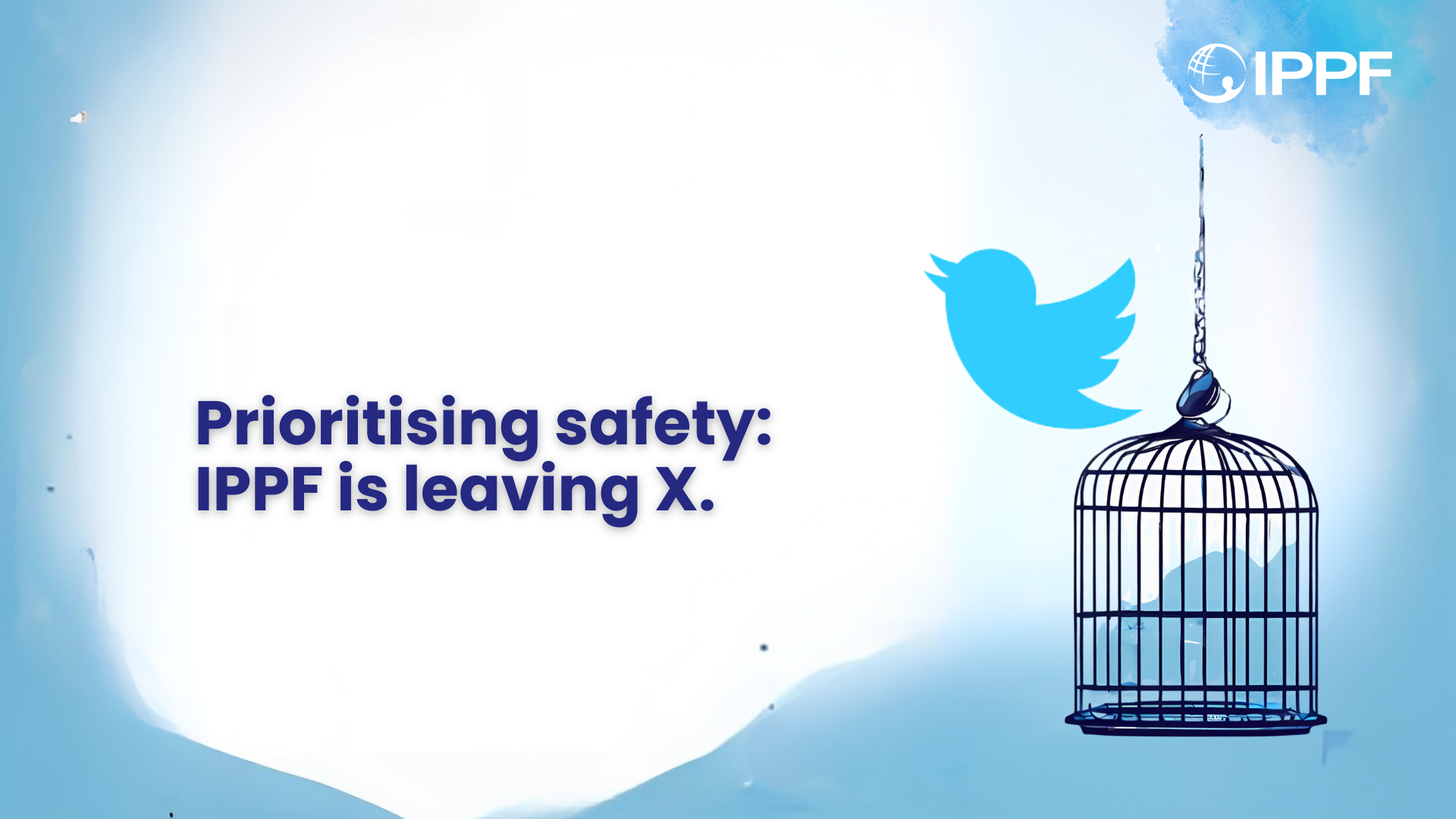
It's time: we're leaving X
As an organisation dedicated to promoting and protecting the health, rights, and dignity of all individuals, we must prioritise the safety and well-being of our community in every space we occupy. After careful consideration, we have decided to leave the platform X, effective 20 January 2025. Unfortunately, X no longer provides the safe and supportive environment that our community deserves. The increasing prevalence of harmful discourse and the platform's failure to adequately address it have made this decision necessary. We are also deeply concerned about Meta’s new policy updates announced in the beginning of January, which raise critical questions about privacy, misinformation, and the safety of vulnerable groups online, including women, migrants, transgender people and the LGBTQIA+ community. As advocates for sexual and reproductive health and rights, we must ensure the digital spaces we engage with uphold the values of equity, inclusion, and accountability. Our commitment to creating meaningful conversations and driving positive change remains steadfast. You can continue to connect with us on LinkedIn, Instagram, or our website, where we will remain active and responsive. To never miss an update, follow us on Instagram and tap the bell icon at the top-right corner on our profile to turn on notifications! link We thank you for your continued support and invite you to join us in advocating for safer and more equitable digital spaces for all. Together, we can build a world where everyone can thrive—online and offline. #DigitalSafety

13 February 2024
Women and Science: A long history of defying stereotypes with determination
Join this inspiring journey! Growing up they said science wasn't for women, but every day proves that the space we want, can and will be ours! From the Americas to the Caribbean islands, women and girls are making our mark by defying stereotypes and overcoming barriers to take our space in science. This article highlights the diversity of young and adult women who make IPPF ACRO a region with a heart for communities and their people. Learn about these incredible women and their experience in science and how they contribute to the area of sexual and reproductive rights, These women scientists have not only expanded our understanding of the world, but are also inspiring future generations of girls to pursue their own scientific passions through their courage, ingenuity and resilience. Let's inspire more women and girls to join the exciting journey of scientific knowledge in the Americas and the Caribbean!

20 February 2023
On this World Day Of Social Justice we call for the protection of ALL activists
On this World Day Of Social Justice, we demand that states be proactive in Overcoming Barriers and Unleashing Opportunities for Social Justice. In 2022 activists won a major victory with the decriminalization of abortion in Colombia, reminding us that despite the obstacles in much of the region there is hope as the green wave spreads thanks to grassroots activism everywhere. In The Caribbean, physical and sexual violence towards trans people often goes unreported as there are no legal mechanisms to acknowledge a change in gender markers - which in itself is a form of violence. And even with arguably some of the largest activist populations both Brazil and Mexico remained the most violent places for Trans people to live in 2022. The United States is the third most dangerous, a statistic which may well increase given the record number of 300+ anti-LGBTQ+ legislation which has been introduced in the first two months of 2023. Despite all of these challenges, LGBTQI+ communities across the region continue to be at the forefront of movements and activism across the region. Local Caribbean activists saw their hard work rewarded in the repeal of colonial-era laws banning same-sex intimacy in 3 countries - Saint Kitts and Nevis, Antigua and Barbuda, and Barbados in 2022. These activists must be protected in order to continue their fight for rights and justice. There are solutions that include all of us, and all eyes are on the governments of our region to provide protection from discrimination and violence.

30 November 2022
'Ready, SEt, Go!' – SE stories from the Federation for World Social Enterprise Day 2022
Through the 'Ready, SEt, Go!' series, the Social Enterprise Hub showcases organizations that received IPPF funding in the 2021/2022 financial year and shares insight and visuals into each Association’s Social Enterprise (SE) journey, from ideation to establishment, learnings and plans for the future. This year there were three Members Association chosen to be featured from the IPPF Americas and Caribbean Region - Peru, Trinidad and Tobago, and Mexico, as well as other organisations. Download the features in .pdf HERE

14 March 2022
IPPF ACRO Humanitarian Training
The IPPF Americas and Caribbean Team (ACRO), together with representatives of Member Associations from Colombia, Trinidad and Tobago, Peru, and Ecuador met in Bogota in March 2022 for a training on implementation of the Minimum Initial Service Package on Sexual and Reproductive Health in humanitarian settings and on addressing gender-based violence led by the IPPF Humanitarian Team. Nearly 40 participants had the opportunity to update their knowledge and learn about new approaches to implementing humanitarian responses in Sexual and Reproductive Health, as well as share their experiences with the implementation of humanitarian responses in the diverse regional context of the Americas and the Caribbean, with particular emphasis on the Venezuelan migration crisis. During the training week, special relevance was given to the issue of coordinating efforts in humanitarian response with other allied actors as well as among the different IPPF Member Associations in the region because the Venezuelan migration crisis is a regional phenomenon. People from Venezuela, especially women, adolescents, and girls, are forced to leave their country due to the precarious economic situation, political instability, insecurity, lack of basic health care, and in other cases due to threats to their lives. They seek refuge in other countries in the region, with Colombia and Peru being the main destinations. Migrants, who travel through entire countries to reach their final destination, face enormous difficulties and barriers in accessing health services in general and sexual and reproductive health services in particular, as well as discrimination and stigma. That through the humanitarian response they access programs and services provided by IPPF Member Associations, including STI and HIV diagnosis and treatment services, family planning, safe abortion care, and survivors of gender-based violence. IPPF Global and ACRO humanitarian team visit to key health care points for migrants from Venezuela. The humanitarian team had the opportunity to visit the points where services are being provided as part of the humanitarian response to Venezuelan migration in the cities of Cúcuta and Santander, which allowed them to learn more about the ongoing response in Colombia, a country that as of January 2021 has received more than 1,700,000 migrants from the neighboring country, according to data from Migration Colombia. IPPF's Humanitarian Program contributes to the consolidation of an innovative model for sexual and reproductive health and rights in crisis situations, connecting key elements of humanitarian action with long-term development. We are one of the world's largest providers of sexual and reproductive health services in emergencies. Sexual and reproductive health and rights in crisis The need for women's reproductive health care is not suspended in crises. A quarter of those affected by crises worldwide are women and girls between the ages of 15 and 49. One in five women is likely to be pregnant and one and five of all births will experience complications. In crisis settings, there is also an increased risk of child, early and forced marriages and unions, sexual violence, unsafe abortions, and unassisted childbirth. Transmission rates of STIs, including HIV, also increase in emergencies. During crises, we work closely with our clinics on the ground to provide life-saving care to people in need. Our mobile health clinics bring comprehensive services to where they are needed by people affected by the crisis.

22 February 2022
History is made as Colombia decriminalizes abortion!
In a groundbreaking decision on the 21st of Feburay 2022, Colombia's Constitutional Court decriminalized abortion during the first 24 weeks of pregnancy. IPPF Americas and The Caribbean (ACRO) stands with Member Association Profamilia as we celebrate this historic decision and recognize the fight of the feminist movement in Colombia for this achievement! In a statement to the Guardian Newspaper Eugenia Lopez Uribe, Regional Director for IPPF ACRO reminded us “While today we are celebrating this historic decision, the Green Wave is strong and growing, and the fight for reproductive rights and justice will not end until every person can access high-quality sexual and reproductive healthcare when and where they need it. From now on a combined system for accessing abortion is considered: 1)Free and legal until 24 weeks of gestation, after this time: 2) the 3 causals (C-355/06) and are as follows: When the pregnancy represents a risk to the physical or mental health of the woman or person with the possibility of gestation. When it is product of sexual violence. And for fetal malformations incompatible with life.
28 January 2021
IPPF welcomes President Biden’s decision to repeal the Global Gag Rule
The International Planned Parenthood Federation (IPPF) welcomes the news of President Biden’s decision to keep his promise and repeal the harmful Global Gag Rule (GGR) - also known as the Mexico City Policy. Since its expanded reintroduction in 2017 by the previous administration, the Global Gag Rule has contributed to an increase in unintended and high-risk pregnancies, unsafe abortions – culminating in unnecessary maternal deaths. For IPPF, 53 healthcare projects in 32 countries were impacted by GGR, with some Member Associations losing up to 60% of their funding. IPPF’s Director-General, Dr Alvaro Bermejo said: “I welcome the decision by President Biden to repeal the Global Gag Rule. “The expanded reintroduction of the gag was callously designed to deny women the right to decide what happens to their body. Whilst we know this policy is intended as a tool to attack abortion care by the anti-choice movement, not only has it led to reproductive coercion, it has cut deeper into healthcare provision: from HIV prevention programs to maternal health to contraceptive access – no one was spared the fallout of this policy. “What lies ahead of us is years of work to undo the harm caused by Global Gag Rule, and to build back a better and stronger relationship with the U.S. – one where our work is not under threat from future anti-sexual and reproductive health administrations. To protect the rights of future generations of women and girls, we ask that the Biden-Harris administration take the necessary steps to permanently repeal the Global Gag Rule. Without a permanent repeal, the global gag remains a constant threat to women, girls, youth and marginalized communities. Reproductive rights, bodily autonomy and the human right to decide what happens to your body cannot be at the mercy of a pen stroke. “IPPF looks on with hope and welcomes the opportunity to work closely with the Biden-Harris administration to protect and advance sexual and reproductive healthcare for all.” And President and CEO, Planned Parenthood Federation of America, Alexis McGill Johnson said: “Over the past four years, the United States didn’t just fail to support global reproductive health care access — it actively blocked it. Today, we applaud the beginning of a new chapter, as the Biden-Harris administration puts an end to the devastating global gag rule, which has prevented millions of people around the world from receiving essential health care. We look forward to working alongside the administration and Congress to pass the Global HER Act, to permanently protect access to sexual and reproductive health care across the globe from changes in White House political control. It is long past time that the United States proudly declares to the world that reproductive rights are human rights.” IPPF would like to thank the international community who stepped in and stepped up to help fill the funding gap that was left by the Global Gag Rule. Together, we will continue to fight and deliver sexual and reproductive health and rights. For media inquiries please contact [email protected] (+44) 2079398227
17 January 2025
It's time: we're leaving X
As an organisation dedicated to promoting and protecting the health, rights, and dignity of all individuals, we must prioritise the safety and well-being of our community in every space we occupy. After careful consideration, we have decided to leave the platform X, effective 20 January 2025. Unfortunately, X no longer provides the safe and supportive environment that our community deserves. The increasing prevalence of harmful discourse and the platform's failure to adequately address it have made this decision necessary. We are also deeply concerned about Meta’s new policy updates announced in the beginning of January, which raise critical questions about privacy, misinformation, and the safety of vulnerable groups online, including women, migrants, transgender people and the LGBTQIA+ community. As advocates for sexual and reproductive health and rights, we must ensure the digital spaces we engage with uphold the values of equity, inclusion, and accountability. Our commitment to creating meaningful conversations and driving positive change remains steadfast. You can continue to connect with us on LinkedIn, Instagram, or our website, where we will remain active and responsive. To never miss an update, follow us on Instagram and tap the bell icon at the top-right corner on our profile to turn on notifications! link We thank you for your continued support and invite you to join us in advocating for safer and more equitable digital spaces for all. Together, we can build a world where everyone can thrive—online and offline. #DigitalSafety
13 February 2024
Women and Science: A long history of defying stereotypes with determination
Join this inspiring journey! Growing up they said science wasn't for women, but every day proves that the space we want, can and will be ours! From the Americas to the Caribbean islands, women and girls are making our mark by defying stereotypes and overcoming barriers to take our space in science. This article highlights the diversity of young and adult women who make IPPF ACRO a region with a heart for communities and their people. Learn about these incredible women and their experience in science and how they contribute to the area of sexual and reproductive rights, These women scientists have not only expanded our understanding of the world, but are also inspiring future generations of girls to pursue their own scientific passions through their courage, ingenuity and resilience. Let's inspire more women and girls to join the exciting journey of scientific knowledge in the Americas and the Caribbean!
20 February 2023
On this World Day Of Social Justice we call for the protection of ALL activists
On this World Day Of Social Justice, we demand that states be proactive in Overcoming Barriers and Unleashing Opportunities for Social Justice. In 2022 activists won a major victory with the decriminalization of abortion in Colombia, reminding us that despite the obstacles in much of the region there is hope as the green wave spreads thanks to grassroots activism everywhere. In The Caribbean, physical and sexual violence towards trans people often goes unreported as there are no legal mechanisms to acknowledge a change in gender markers - which in itself is a form of violence. And even with arguably some of the largest activist populations both Brazil and Mexico remained the most violent places for Trans people to live in 2022. The United States is the third most dangerous, a statistic which may well increase given the record number of 300+ anti-LGBTQ+ legislation which has been introduced in the first two months of 2023. Despite all of these challenges, LGBTQI+ communities across the region continue to be at the forefront of movements and activism across the region. Local Caribbean activists saw their hard work rewarded in the repeal of colonial-era laws banning same-sex intimacy in 3 countries - Saint Kitts and Nevis, Antigua and Barbuda, and Barbados in 2022. These activists must be protected in order to continue their fight for rights and justice. There are solutions that include all of us, and all eyes are on the governments of our region to provide protection from discrimination and violence.
30 November 2022
'Ready, SEt, Go!' – SE stories from the Federation for World Social Enterprise Day 2022
Through the 'Ready, SEt, Go!' series, the Social Enterprise Hub showcases organizations that received IPPF funding in the 2021/2022 financial year and shares insight and visuals into each Association’s Social Enterprise (SE) journey, from ideation to establishment, learnings and plans for the future. This year there were three Members Association chosen to be featured from the IPPF Americas and Caribbean Region - Peru, Trinidad and Tobago, and Mexico, as well as other organisations. Download the features in .pdf HERE
14 March 2022
IPPF ACRO Humanitarian Training
The IPPF Americas and Caribbean Team (ACRO), together with representatives of Member Associations from Colombia, Trinidad and Tobago, Peru, and Ecuador met in Bogota in March 2022 for a training on implementation of the Minimum Initial Service Package on Sexual and Reproductive Health in humanitarian settings and on addressing gender-based violence led by the IPPF Humanitarian Team. Nearly 40 participants had the opportunity to update their knowledge and learn about new approaches to implementing humanitarian responses in Sexual and Reproductive Health, as well as share their experiences with the implementation of humanitarian responses in the diverse regional context of the Americas and the Caribbean, with particular emphasis on the Venezuelan migration crisis. During the training week, special relevance was given to the issue of coordinating efforts in humanitarian response with other allied actors as well as among the different IPPF Member Associations in the region because the Venezuelan migration crisis is a regional phenomenon. People from Venezuela, especially women, adolescents, and girls, are forced to leave their country due to the precarious economic situation, political instability, insecurity, lack of basic health care, and in other cases due to threats to their lives. They seek refuge in other countries in the region, with Colombia and Peru being the main destinations. Migrants, who travel through entire countries to reach their final destination, face enormous difficulties and barriers in accessing health services in general and sexual and reproductive health services in particular, as well as discrimination and stigma. That through the humanitarian response they access programs and services provided by IPPF Member Associations, including STI and HIV diagnosis and treatment services, family planning, safe abortion care, and survivors of gender-based violence. IPPF Global and ACRO humanitarian team visit to key health care points for migrants from Venezuela. The humanitarian team had the opportunity to visit the points where services are being provided as part of the humanitarian response to Venezuelan migration in the cities of Cúcuta and Santander, which allowed them to learn more about the ongoing response in Colombia, a country that as of January 2021 has received more than 1,700,000 migrants from the neighboring country, according to data from Migration Colombia. IPPF's Humanitarian Program contributes to the consolidation of an innovative model for sexual and reproductive health and rights in crisis situations, connecting key elements of humanitarian action with long-term development. We are one of the world's largest providers of sexual and reproductive health services in emergencies. Sexual and reproductive health and rights in crisis The need for women's reproductive health care is not suspended in crises. A quarter of those affected by crises worldwide are women and girls between the ages of 15 and 49. One in five women is likely to be pregnant and one and five of all births will experience complications. In crisis settings, there is also an increased risk of child, early and forced marriages and unions, sexual violence, unsafe abortions, and unassisted childbirth. Transmission rates of STIs, including HIV, also increase in emergencies. During crises, we work closely with our clinics on the ground to provide life-saving care to people in need. Our mobile health clinics bring comprehensive services to where they are needed by people affected by the crisis.
22 February 2022
History is made as Colombia decriminalizes abortion!
In a groundbreaking decision on the 21st of Feburay 2022, Colombia's Constitutional Court decriminalized abortion during the first 24 weeks of pregnancy. IPPF Americas and The Caribbean (ACRO) stands with Member Association Profamilia as we celebrate this historic decision and recognize the fight of the feminist movement in Colombia for this achievement! In a statement to the Guardian Newspaper Eugenia Lopez Uribe, Regional Director for IPPF ACRO reminded us “While today we are celebrating this historic decision, the Green Wave is strong and growing, and the fight for reproductive rights and justice will not end until every person can access high-quality sexual and reproductive healthcare when and where they need it. From now on a combined system for accessing abortion is considered: 1)Free and legal until 24 weeks of gestation, after this time: 2) the 3 causals (C-355/06) and are as follows: When the pregnancy represents a risk to the physical or mental health of the woman or person with the possibility of gestation. When it is product of sexual violence. And for fetal malformations incompatible with life.
28 January 2021
IPPF welcomes President Biden’s decision to repeal the Global Gag Rule
The International Planned Parenthood Federation (IPPF) welcomes the news of President Biden’s decision to keep his promise and repeal the harmful Global Gag Rule (GGR) - also known as the Mexico City Policy. Since its expanded reintroduction in 2017 by the previous administration, the Global Gag Rule has contributed to an increase in unintended and high-risk pregnancies, unsafe abortions – culminating in unnecessary maternal deaths. For IPPF, 53 healthcare projects in 32 countries were impacted by GGR, with some Member Associations losing up to 60% of their funding. IPPF’s Director-General, Dr Alvaro Bermejo said: “I welcome the decision by President Biden to repeal the Global Gag Rule. “The expanded reintroduction of the gag was callously designed to deny women the right to decide what happens to their body. Whilst we know this policy is intended as a tool to attack abortion care by the anti-choice movement, not only has it led to reproductive coercion, it has cut deeper into healthcare provision: from HIV prevention programs to maternal health to contraceptive access – no one was spared the fallout of this policy. “What lies ahead of us is years of work to undo the harm caused by Global Gag Rule, and to build back a better and stronger relationship with the U.S. – one where our work is not under threat from future anti-sexual and reproductive health administrations. To protect the rights of future generations of women and girls, we ask that the Biden-Harris administration take the necessary steps to permanently repeal the Global Gag Rule. Without a permanent repeal, the global gag remains a constant threat to women, girls, youth and marginalized communities. Reproductive rights, bodily autonomy and the human right to decide what happens to your body cannot be at the mercy of a pen stroke. “IPPF looks on with hope and welcomes the opportunity to work closely with the Biden-Harris administration to protect and advance sexual and reproductive healthcare for all.” And President and CEO, Planned Parenthood Federation of America, Alexis McGill Johnson said: “Over the past four years, the United States didn’t just fail to support global reproductive health care access — it actively blocked it. Today, we applaud the beginning of a new chapter, as the Biden-Harris administration puts an end to the devastating global gag rule, which has prevented millions of people around the world from receiving essential health care. We look forward to working alongside the administration and Congress to pass the Global HER Act, to permanently protect access to sexual and reproductive health care across the globe from changes in White House political control. It is long past time that the United States proudly declares to the world that reproductive rights are human rights.” IPPF would like to thank the international community who stepped in and stepped up to help fill the funding gap that was left by the Global Gag Rule. Together, we will continue to fight and deliver sexual and reproductive health and rights. For media inquiries please contact [email protected] (+44) 2079398227