- - -

Articles about Barbados

27 October 2023

Capacity Statement - Barbados

Photography by Wara Vargas Lara for IPPF - Bolivia s28 2022
20 February 2023

On this World Day Of Social Justice we call for the protection of ALL activists

On this World Day Of Social Justice, we demand that states be proactive in Overcoming Barriers and Unleashing Opportunities for Social Justice.  In 2022 activists won a major victory with the decriminalization of abortion in Colombia, reminding us that despite the obstacles in much of the region there is hope as the green wave spreads thanks to grassroots activism everywhere. In The Caribbean, physical and sexual violence towards trans people often goes unreported as there are no legal mechanisms to acknowledge a change in gender markers - which in itself is a form of violence. And even with arguably some of the largest activist populations both Brazil and Mexico remained the most violent places for Trans people to live in 2022. The United States is the third most dangerous, a statistic which may well increase given the record number of 300+ anti-LGBTQ+ legislation which has been introduced in the first two months of 2023.       Despite all of these challenges, LGBTQI+ communities across the region continue to be at the forefront of movements and activism across the region. Local Caribbean activists saw their hard work rewarded in the repeal of colonial-era laws banning same-sex intimacy in 3 countries - Saint Kitts and Nevis, Antigua and Barbuda, and Barbados in 2022.  These activists must be protected in order to continue their fight for rights and justice.  There are solutions that include all of us, and all eyes are on the governments of our region to provide protection from discrimination and violence.  

flags
13 December 2022

Barbados strikes down anti-gay laws!

In a historic day for the LGBTQ+ community of Barbados, the High Court struck down colonial-era laws which were used to discriminate against LGBTQ+ people in the island, and further infringe their human rights by promoting violence towards the community.   The decision struck down Sections 9 and 12 of the Barbados Sexual Offences Act, also known as the “buggery” and “indecency” laws, which criminalized consensual same-sex intimacy. Under Section 9, punishment for breaking the law could be as severe as life imprisonment for men who engaged in same-sex sexual activity. Under Section 12, men, as well as women, were criminalized and liable to imprisonment of up to 10 years. The oral ruling was given on the 12th Decemnber 2022, with a written decision to come in early 2023, and was the third such ruling in the Caribbean this year with both Antigua and Barbuda and St Kitts and Nevis striking down similar laws, showing that significant progress is being made even within its challenging context.  The case was filed by Barbadian LGBTQ+ advocates with local LGBTQ+ organization Equals providing community support, and with the regional LGBT umbrella organization, Eastern Caribbean Alliance for Diversity and Equality facilitating. Michael Rapley, Chair of Equals Barbados told IPPF Americas and The Caribbean “While this is a major step towards equality in Barbados, there is still work to be done to address the lack of protections that LGBTQ+ people in Barbados face, as well as a need to create positive public perceptions of the community.” During this moment of celebration, we are reminded that there is still much to be done. LGBQT+ people living in the Caribbean are reporting rising discrimination and harassment, even barriers to accessing basic services. This highlights the real work being done on the ground which regional and international organizations must continue to support in order to strengthen these organizations while using our voices to advocate for social and legislative change.  IPPF ACRO stands in strong solidarity with the people of Barbados, and LGBTQ+ people throughout the region who continue to fight for their rights and freedom from stigma and discrimination. “We will not stop until everyone in our region is afforded the rights and freedoms to which they are entitled. We congratulate all those who have contributed to the progress made in the Caribbean this year. IPPF ACRO remains committed to being a strong ally in the work still to be done.” Dona Da Costa Martinez – IPPF ACRO Deputy Regional Director.  

barbadoa

“At BFPA, we don’t turn away anyone”

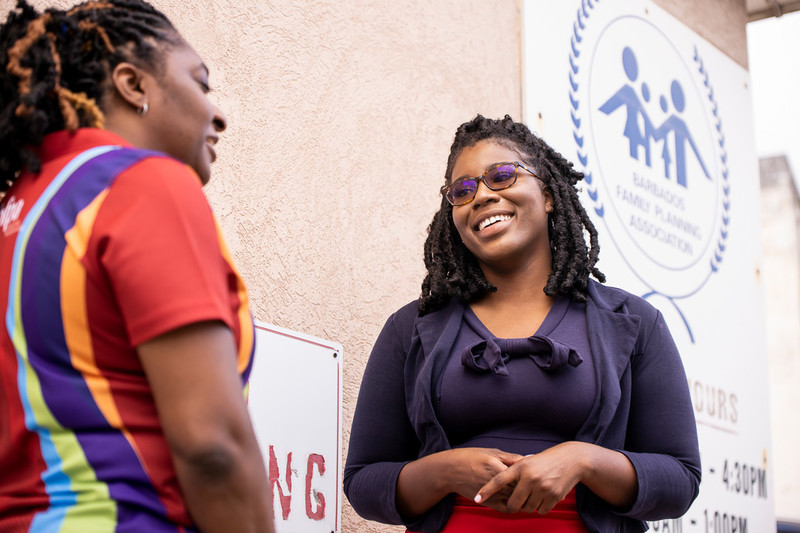
Keriann Hurley has worked at the Barbados Family Planning Association (BFPA) for 15 years. She is a social worker and the Manager of Youth Programming, but art is another passion of hers.  A link between art and social work may not seem evident but Keriann explains that combining her passions “helps to fuel the type of interventions I do with the clients.” Keriann is proud that “here at BFPA, our niche and the thing that we do amazingly well, above anyone else I dare say, is how we deal with Sexual and Reproductive Health issues, but that’s not all we do”. “Sexuality and sexual health is only one aspect of your existence”, she says. She is clear that BFPA’s services must consider gender, sexual identity, sexual orientation, mental health, family circumstances and relationships in its service delivery if it is to truly serve the community. There is a real need to provide unhindered access to young people who require services In Barbados, the age of consent is 16 but “there is still the issue of the age of access versus the age of consent.” Keriann explained that there’s no legal framework that prevents young people between 16 and 18 from accessing SRH services; there is the cultural “assumption that they must bring parent/guardian to be seen by a medical professional.” “A young person isn’t just going to show up at a doctor’s office because they think it’s the cool thing to do. There must be a dire reason”, Keriann says, and she adds that many young people do not access services because they fear judgement and punishment. “At BFPA, we don’t turn away anyone” A key task of the BFPA is to facilitate young people’s access to SRH services. BFPA established legally compliant protocols which govern their engagement with young people. Social Workers like Keriann comprehensively assess the personal circumstances of each young person to ensure that they are provided with the appropriate care. “Not every young person has a parent or guardian who will come with them, but should they be turned away if they have a dire need? No, it’s unethical to do that. At BFPA, we don’t turn away anyone”, she says. Sometimes a young person does have an available parent or guardian but fears their reaction to their desire to access SRH services. In these situations, she acts as a mediator to facilitate conversation between the young person and their caretaker. With the years passing, it became clear to Keriann that the challenge is “dealing with age-old issues in new ways. There is nothing new under the sun. However, issues do come back around in new ways”. The significance of certain issues changes with the times. “Just look at social media!” she says, “it also means that information, and misinformation, is easily accessible.” Keriann has seen a shift in societal attitudes towards SRH over the last 5 years. A plus side of the internet, she says, is that the accessibility of information means that society cannot “bury its head in the sand and pretend that young people aren’t sexually exploring.” “The Young Mothers Programme is my baby” In 2011, Keriann started this 10-year programme. The majority of Barbadian households are female-headed and she recognises that empowering young mothers will have a powerful positive impact on society. “These girls come with heavy issues,” Keriann says. Beneficiaries are taught not just parenting skills but life skills. They have access to intensive psychosocial counselling for themselves, partners and family members and vocational training. The Young Mothers Programme has transitioned to online delivery which poses such as lack of devices, electricity or a conducive household environment, and unreliability or absence of internet access. “Suddenly there was a new normal before we could even figure out what that meant”, Keriann says. Online delivery is more tiring, and she admits the difficulty in balancing delivery of a quality programme without an unsustainable psychological cost to herself but is adamant that “it is better to have a meaningful impact on 10 people than surface level engagement with 100”. Keriann believes that “the wealth and health of a society is based on how we take care of the most vulnerable. Working in an organisation whose focus is primarily the most vulnerable is really rewarding”. Keriann shares that social work is one of least financially viable careers in Barbados. “Many months we just try to get by, but the work is really rewarding!” she laughed, “We are here grinding on and doing what we have to do to make sure that we provide quality services to the most vulnerable in our community and not leaving anyone behind”
Dr. Rashida Daisley is the 31-year-old Clinical Director of the Barbados Family Planning Association (BFPA)

“I have a passion for working with key populations"

Dr. Rashida Daisley is the 31-year-old Clinical Director of the Barbados Family Planning Association (BFPA) and is also the president of the Barbados Association of Endometriosis and Polycystic Ovarian Syndrome (BAEP). “I have a passion for working with key populations and that’s what lead me to work at BFPA,” She says and takes pride in BFPA's continued leadership of sexual and reproductive health services in Barbados. Offering a spectrum of gynecological care while also conducting specialized clinics, steadily expanding its practice to include more general services including antenatal care. There is a men’s clinic that addresses both SRH and physical and emotional wellbeing while BFPA’s surgical clinic offers minor surgeries such as hernia repair, lumpectomies, and vasectomies. Despite funding challenges, BFPA has committed to providing critical support to the under-served LGBTQ+ community in Barbados by partnering with NGO - Sexuality, Health and Empowerment (SHE) to provide affordable, high quality and inclusive health services to lesbians, bisexual and queer women, as well as non-binary and transgender persons - an effort spearheaded personally by Dr. Daisley, while also supporting pre-exposure prophylaxis (PrEp) and STI clinics at Equals Barbados, another LBGTQ+ organization on the island.   COVID-19 and filling the gaps Dr. Daisley says she is pleased that clinical services were able to continue throughout the pandemic, unfortunately, COVID-19 has had a devastating impact on Barbados’ economy and society. As a tourism-dependent nation, a large proportion of the Barbadian workforce became unemployed in a very short period which in turn negatively affected the ability of marginalized persons to access basic services or even basic hygiene products. BFPA sought funding and donations to fill this gap and was able to secure funding from international organizations such as UNFPA, as well as donations of sanitary items from the Lady Box Project, a local NGO aimed at ending period poverty.  With funding from IPPF assisting in the provision of services to key populations such as persons living with HIV, men who have sex with men, sex workers, and LGBTQ+ persons. The allocation of funds to provide services to these groups allowed BFPA the financial space to direct its efforts to their other clients. Perhaps surprisingly, a relatively large subset of BFPA’s clients are older persons.  “The majority of people that BFPA interacts with are pretty open but that is probably because the people who seek out BFPA are already open-minded enough to access services at an organization with the words ‘family planning’”, Dr. Daisley laughed, “we do get a lot of referrals.” Perhaps surprisingly, a relatively large subset of BFPA’s clients are older people, many of whom started coming to BFPA as young people, while a small number of older persons do still seek out services because they are sexually active. Unfortunately, they grew up in a social climate where sexual and reproductive health education was virtually non-existent and the work to provide them better access is ongoing.  Dr. Daisley explains that the older population often do not think that they need to see the doctor about their sexual activity because there is no possibility of pregnancy. They are also not aware of the breadth of STI testing available. “When I ask them when was their last STI test, they usually say a few years ago at a health fair.” When probed, many of them disclose that they have only ever been tested for HIV and are not aware of many of the other STIs. In contrast, younger persons tend to have a healthier and more informed approach to sex and sexuality. Dr. Daisley observes that there is an increase in young people coming to be tested with their partners, and she attributes this in part to the important work that the BFPA’s Youth Advocacy Movement has done over the years, and essential to the progress of comprehensive sexual education.     

Barbados Family Planning Association (BFPA)

The BFPA also known as the Barbados Family Planning Association is a benevolent organization created to protect, serve, and empower every Barbadian with their Sexual and Reproductive Health and Rights embedded in a human and Sexual rights approach.

The Association carries out its mission in the following ways clinical and medical service; education; national, community and individual intervention programs; strategic advocacy; intense research; provision of data; and most importantly protecting the most vulnerable and marginalised groups in society. It was established by an act of Parliament in 1954 and governed by an elected group of volunteers.

The Association is an independent entity and governed by a constitution. The BFPA for transparency and accountability is governed by a Board of Ten (10) Elected Directors (President, Vice President, Secretary, Treasurer, Public Relation Officer and Five Floor members which consist of two youth members). For further accountability and transparency, several government agencies have ex-officio representatives on the Board these are the Ministry of Health and Wellness, the Ministry of Youth Affairs, the Ministry of Education and Innovation, and the private sector. The diversity is further reflected through our Board and member with additional ex-officio e.g., LGBTQI Persons, Women’s groups, youth, and other partners.

The Association is operationally managed by an Executive Director who is supported by highly technical, skilled, and qualified staff. Through a well-managed and sustainable revitalization process, the BFPA membership and board reflects the diversity that is in Barbados, with the following characteristics:  age, ethnicity, religious preference, disability, sexuality, and socio-economic diversity.

The BFPA has one location which is a comprehensive clinical facility and community social service hub. With the reorganisation of the work of the BFPA under the societal impact and sustainability pillars of Medical and Clinical Services, Commodity Distribution, Sexual Rights Advocacy and Intervention Programming, Counselling and Mental Health Support, and lastly the protection of the freedom of all to have Sexual Pleasure in a safe, respectful, and private manner.


Instagram


27 October 2023

Capacity Statement - Barbados

Photography by Wara Vargas Lara for IPPF - Bolivia s28 2022
20 February 2023

On this World Day Of Social Justice we call for the protection of ALL activists

On this World Day Of Social Justice, we demand that states be proactive in Overcoming Barriers and Unleashing Opportunities for Social Justice.  In 2022 activists won a major victory with the decriminalization of abortion in Colombia, reminding us that despite the obstacles in much of the region there is hope as the green wave spreads thanks to grassroots activism everywhere. In The Caribbean, physical and sexual violence towards trans people often goes unreported as there are no legal mechanisms to acknowledge a change in gender markers - which in itself is a form of violence. And even with arguably some of the largest activist populations both Brazil and Mexico remained the most violent places for Trans people to live in 2022. The United States is the third most dangerous, a statistic which may well increase given the record number of 300+ anti-LGBTQ+ legislation which has been introduced in the first two months of 2023.       Despite all of these challenges, LGBTQI+ communities across the region continue to be at the forefront of movements and activism across the region. Local Caribbean activists saw their hard work rewarded in the repeal of colonial-era laws banning same-sex intimacy in 3 countries - Saint Kitts and Nevis, Antigua and Barbuda, and Barbados in 2022.  These activists must be protected in order to continue their fight for rights and justice.  There are solutions that include all of us, and all eyes are on the governments of our region to provide protection from discrimination and violence.  

flags
13 December 2022

Barbados strikes down anti-gay laws!

In a historic day for the LGBTQ+ community of Barbados, the High Court struck down colonial-era laws which were used to discriminate against LGBTQ+ people in the island, and further infringe their human rights by promoting violence towards the community.   The decision struck down Sections 9 and 12 of the Barbados Sexual Offences Act, also known as the “buggery” and “indecency” laws, which criminalized consensual same-sex intimacy. Under Section 9, punishment for breaking the law could be as severe as life imprisonment for men who engaged in same-sex sexual activity. Under Section 12, men, as well as women, were criminalized and liable to imprisonment of up to 10 years. The oral ruling was given on the 12th Decemnber 2022, with a written decision to come in early 2023, and was the third such ruling in the Caribbean this year with both Antigua and Barbuda and St Kitts and Nevis striking down similar laws, showing that significant progress is being made even within its challenging context.  The case was filed by Barbadian LGBTQ+ advocates with local LGBTQ+ organization Equals providing community support, and with the regional LGBT umbrella organization, Eastern Caribbean Alliance for Diversity and Equality facilitating. Michael Rapley, Chair of Equals Barbados told IPPF Americas and The Caribbean “While this is a major step towards equality in Barbados, there is still work to be done to address the lack of protections that LGBTQ+ people in Barbados face, as well as a need to create positive public perceptions of the community.” During this moment of celebration, we are reminded that there is still much to be done. LGBQT+ people living in the Caribbean are reporting rising discrimination and harassment, even barriers to accessing basic services. This highlights the real work being done on the ground which regional and international organizations must continue to support in order to strengthen these organizations while using our voices to advocate for social and legislative change.  IPPF ACRO stands in strong solidarity with the people of Barbados, and LGBTQ+ people throughout the region who continue to fight for their rights and freedom from stigma and discrimination. “We will not stop until everyone in our region is afforded the rights and freedoms to which they are entitled. We congratulate all those who have contributed to the progress made in the Caribbean this year. IPPF ACRO remains committed to being a strong ally in the work still to be done.” Dona Da Costa Martinez – IPPF ACRO Deputy Regional Director.  

barbadoa

“At BFPA, we don’t turn away anyone”

Keriann Hurley has worked at the Barbados Family Planning Association (BFPA) for 15 years. She is a social worker and the Manager of Youth Programming, but art is another passion of hers.  A link between art and social work may not seem evident but Keriann explains that combining her passions “helps to fuel the type of interventions I do with the clients.” Keriann is proud that “here at BFPA, our niche and the thing that we do amazingly well, above anyone else I dare say, is how we deal with Sexual and Reproductive Health issues, but that’s not all we do”. “Sexuality and sexual health is only one aspect of your existence”, she says. She is clear that BFPA’s services must consider gender, sexual identity, sexual orientation, mental health, family circumstances and relationships in its service delivery if it is to truly serve the community. There is a real need to provide unhindered access to young people who require services In Barbados, the age of consent is 16 but “there is still the issue of the age of access versus the age of consent.” Keriann explained that there’s no legal framework that prevents young people between 16 and 18 from accessing SRH services; there is the cultural “assumption that they must bring parent/guardian to be seen by a medical professional.” “A young person isn’t just going to show up at a doctor’s office because they think it’s the cool thing to do. There must be a dire reason”, Keriann says, and she adds that many young people do not access services because they fear judgement and punishment. “At BFPA, we don’t turn away anyone” A key task of the BFPA is to facilitate young people’s access to SRH services. BFPA established legally compliant protocols which govern their engagement with young people. Social Workers like Keriann comprehensively assess the personal circumstances of each young person to ensure that they are provided with the appropriate care. “Not every young person has a parent or guardian who will come with them, but should they be turned away if they have a dire need? No, it’s unethical to do that. At BFPA, we don’t turn away anyone”, she says. Sometimes a young person does have an available parent or guardian but fears their reaction to their desire to access SRH services. In these situations, she acts as a mediator to facilitate conversation between the young person and their caretaker. With the years passing, it became clear to Keriann that the challenge is “dealing with age-old issues in new ways. There is nothing new under the sun. However, issues do come back around in new ways”. The significance of certain issues changes with the times. “Just look at social media!” she says, “it also means that information, and misinformation, is easily accessible.” Keriann has seen a shift in societal attitudes towards SRH over the last 5 years. A plus side of the internet, she says, is that the accessibility of information means that society cannot “bury its head in the sand and pretend that young people aren’t sexually exploring.” “The Young Mothers Programme is my baby” In 2011, Keriann started this 10-year programme. The majority of Barbadian households are female-headed and she recognises that empowering young mothers will have a powerful positive impact on society. “These girls come with heavy issues,” Keriann says. Beneficiaries are taught not just parenting skills but life skills. They have access to intensive psychosocial counselling for themselves, partners and family members and vocational training. The Young Mothers Programme has transitioned to online delivery which poses such as lack of devices, electricity or a conducive household environment, and unreliability or absence of internet access. “Suddenly there was a new normal before we could even figure out what that meant”, Keriann says. Online delivery is more tiring, and she admits the difficulty in balancing delivery of a quality programme without an unsustainable psychological cost to herself but is adamant that “it is better to have a meaningful impact on 10 people than surface level engagement with 100”. Keriann believes that “the wealth and health of a society is based on how we take care of the most vulnerable. Working in an organisation whose focus is primarily the most vulnerable is really rewarding”. Keriann shares that social work is one of least financially viable careers in Barbados. “Many months we just try to get by, but the work is really rewarding!” she laughed, “We are here grinding on and doing what we have to do to make sure that we provide quality services to the most vulnerable in our community and not leaving anyone behind”

Dr. Rashida Daisley is the 31-year-old Clinical Director of the Barbados Family Planning Association (BFPA)

“I have a passion for working with key populations"

Dr. Rashida Daisley is the 31-year-old Clinical Director of the Barbados Family Planning Association (BFPA) and is also the president of the Barbados Association of Endometriosis and Polycystic Ovarian Syndrome (BAEP). “I have a passion for working with key populations and that’s what lead me to work at BFPA,” She says and takes pride in BFPA's continued leadership of sexual and reproductive health services in Barbados. Offering a spectrum of gynecological care while also conducting specialized clinics, steadily expanding its practice to include more general services including antenatal care. There is a men’s clinic that addresses both SRH and physical and emotional wellbeing while BFPA’s surgical clinic offers minor surgeries such as hernia repair, lumpectomies, and vasectomies. Despite funding challenges, BFPA has committed to providing critical support to the under-served LGBTQ+ community in Barbados by partnering with NGO - Sexuality, Health and Empowerment (SHE) to provide affordable, high quality and inclusive health services to lesbians, bisexual and queer women, as well as non-binary and transgender persons - an effort spearheaded personally by Dr. Daisley, while also supporting pre-exposure prophylaxis (PrEp) and STI clinics at Equals Barbados, another LBGTQ+ organization on the island.   COVID-19 and filling the gaps Dr. Daisley says she is pleased that clinical services were able to continue throughout the pandemic, unfortunately, COVID-19 has had a devastating impact on Barbados’ economy and society. As a tourism-dependent nation, a large proportion of the Barbadian workforce became unemployed in a very short period which in turn negatively affected the ability of marginalized persons to access basic services or even basic hygiene products. BFPA sought funding and donations to fill this gap and was able to secure funding from international organizations such as UNFPA, as well as donations of sanitary items from the Lady Box Project, a local NGO aimed at ending period poverty.  With funding from IPPF assisting in the provision of services to key populations such as persons living with HIV, men who have sex with men, sex workers, and LGBTQ+ persons. The allocation of funds to provide services to these groups allowed BFPA the financial space to direct its efforts to their other clients. Perhaps surprisingly, a relatively large subset of BFPA’s clients are older persons.  “The majority of people that BFPA interacts with are pretty open but that is probably because the people who seek out BFPA are already open-minded enough to access services at an organization with the words ‘family planning’”, Dr. Daisley laughed, “we do get a lot of referrals.” Perhaps surprisingly, a relatively large subset of BFPA’s clients are older people, many of whom started coming to BFPA as young people, while a small number of older persons do still seek out services because they are sexually active. Unfortunately, they grew up in a social climate where sexual and reproductive health education was virtually non-existent and the work to provide them better access is ongoing.  Dr. Daisley explains that the older population often do not think that they need to see the doctor about their sexual activity because there is no possibility of pregnancy. They are also not aware of the breadth of STI testing available. “When I ask them when was their last STI test, they usually say a few years ago at a health fair.” When probed, many of them disclose that they have only ever been tested for HIV and are not aware of many of the other STIs. In contrast, younger persons tend to have a healthier and more informed approach to sex and sexuality. Dr. Daisley observes that there is an increase in young people coming to be tested with their partners, and she attributes this in part to the important work that the BFPA’s Youth Advocacy Movement has done over the years, and essential to the progress of comprehensive sexual education.     

Barbados Family Planning Association (BFPA)

The BFPA also known as the Barbados Family Planning Association is a benevolent organization created to protect, serve, and empower every Barbadian with their Sexual and Reproductive Health and Rights embedded in a human and Sexual rights approach.

The Association carries out its mission in the following ways clinical and medical service; education; national, community and individual intervention programs; strategic advocacy; intense research; provision of data; and most importantly protecting the most vulnerable and marginalised groups in society. It was established by an act of Parliament in 1954 and governed by an elected group of volunteers.

The Association is an independent entity and governed by a constitution. The BFPA for transparency and accountability is governed by a Board of Ten (10) Elected Directors (President, Vice President, Secretary, Treasurer, Public Relation Officer and Five Floor members which consist of two youth members). For further accountability and transparency, several government agencies have ex-officio representatives on the Board these are the Ministry of Health and Wellness, the Ministry of Youth Affairs, the Ministry of Education and Innovation, and the private sector. The diversity is further reflected through our Board and member with additional ex-officio e.g., LGBTQI Persons, Women’s groups, youth, and other partners.

The Association is operationally managed by an Executive Director who is supported by highly technical, skilled, and qualified staff. Through a well-managed and sustainable revitalization process, the BFPA membership and board reflects the diversity that is in Barbados, with the following characteristics:  age, ethnicity, religious preference, disability, sexuality, and socio-economic diversity.

The BFPA has one location which is a comprehensive clinical facility and community social service hub. With the reorganisation of the work of the BFPA under the societal impact and sustainability pillars of Medical and Clinical Services, Commodity Distribution, Sexual Rights Advocacy and Intervention Programming, Counselling and Mental Health Support, and lastly the protection of the freedom of all to have Sexual Pleasure in a safe, respectful, and private manner.


Instagram